Why Should Specifiers Ask Manufacturers for an EPD?
Sustainability claims are now common throughout the construction and commercial-interiors sectors. Words such as “green”, “eco-friendly” and “low impact” appear regularly in product literature, but without supporting evidence, it can be difficult for specifiers to understand what those claims actually mean.
An Environmental Product Declaration, commonly known as an EPD, provides a more transparent approach. It gives architects, designers, contractors and clients standardised environmental information that can be considered alongside cost, quality, durability and technical performance.
For project teams seeking to make informed material choices, asking manufacturers for an EPD is becoming an increasingly important part of responsible specification.
What Is an Environmental Product Declaration?
An EPD is a document that communicates quantified information about a product’s environmental impacts. Its findings are based on a lifecycle assessment and presented according to recognised rules and standards.
Depending on the declared scope, the assessment may consider stages such as:
- Raw-material sourcing
- Manufacturing
- Energy and resource consumption
- Transportation
- Installation
- Use and maintenance
- End-of-life treatment
- Reuse, recovery or disposal
A credible EPD is independently verified before publication. This gives project teams greater confidence that the methodology and information have been reviewed rather than being based solely on an unsupported statement from the manufacturer.
An EPD Is About Transparency, Not a Sustainability Badge
An important distinction is that an EPD does not automatically prove that a product is sustainable.
It is not simply a pass-or-fail environmental certificate, nor does its existence necessarily mean that one product has a lower impact than every alternative. Instead, it provides structured information that allows environmental performance to be examined more carefully.
This distinction protects specifiers from relying on broad marketing language. Rather than accepting a claim that a product is “environmentally friendly”, the project team can ask:
- Which environmental impacts have been assessed?
- Which lifecycle stages are included?
- What assumptions and boundaries were used?
- Has the information been independently verified?
- Is the declaration current and applicable to the product being specified?
The result is a more evidence-led conversation.
Why Do EPDs Matter to Specifiers?
They provide credible environmental information.
An EPD gives specifiers access to quantified information supported by a recognised assessment process. This helps replace vague claims with data that can be reviewed by sustainability consultants, architects and other members of the design team.
They support lifecycle assessment
The environmental impact of a building is influenced by the products and materials used throughout it. Product-level information can feed into a whole-building lifecycle assessment, helping project teams understand embodied impacts and identify opportunities for improvement.
Without suitable product data, assessors may need to use generic information or assumptions that do not accurately represent the product selected.
They can support project sustainability objectives
Projects working towards BREEAM, WELL, LEED or client-specific ESG objectives may require environmental information from manufacturers.
An EPD does not automatically provide certification credits, and its contribution depends on the requirements of the particular assessment. However, it can give the project team verified information that supports environmental evaluation and documentation.
Specifiers should always confirm the exact requirements with the project’s appointed sustainability professional.
They encourage manufacturers to understand their impacts
Preparing an EPD requires a manufacturer to examine material use, production, transportation and other relevant lifecycle stages.
This process can identify where impacts occur and provide a baseline against which future improvements can be measured. It encourages environmental management based on evidence rather than slogans.
They improve accountability
Published environmental information makes it easier for clients and project teams to question claims and assess whether stated improvements are meaningful.
It also allows manufacturers to communicate environmental performance in a more consistent and responsible way.
Can EPDs Be Used to Compare Products?
EPDs can contribute to product comparisons, but they must be interpreted carefully.
Two headline figures should not be compared unless the declarations use compatible product-category rules, functional or declared units, lifecycle boundaries, data periods and assessment methods. Products must also satisfy the same technical and performance requirements.
For example, a lower initial manufacturing impact may not represent the best whole-life outcome if the product needs frequent maintenance or premature replacement.
Durability, service life, suitability and the consequences of failure should therefore remain part of the specification decision.
Where a direct comparison is required, advice should be obtained from a suitably qualified lifecycle or sustainability professional.
Why Whole-Life Performance Matters
Environmental assessment should not end at the factory gate.
A product that protects surrounding materials, performs reliably and avoids repeated replacement may provide benefits over the life of a building. Conversely, a poorly suited product may create waste, disruption and additional material use if it fails early.
For architectural planters, long-term considerations can include:
- Resistance to water and moisture
- Root resistance
- Protection of joinery and building fabric
- Expected service life
- Maintenance requirements
- Weight and transportation
- Replacement and refurbishment
- End-of-life options
These performance factors should be evaluated alongside the environmental data contained in an EPD.
Our Approach at Planter Protect
Planter Protect manufactures bespoke waterproof GRP planter inserts for architectural, commercial and landscape applications.
Our inserts are manufactured using GRP incorporating PET resin derived from recycled plastic sources. They are designed to provide durable, root-resistant waterproofing while protecting surrounding joinery and building fabric.
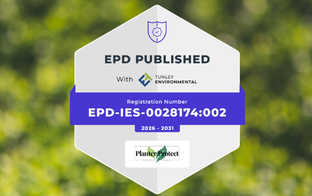
We have obtained a third-party verified EPD for our planter inserts. This gives architects, designers, contractors and sustainability professionals access to transparent lifecycle information when assessing our products for a project.
Our wider approach also includes:
- Designing inserts for durability and long service life
- Using lightweight construction to support handling and transport efficiency
- Delivering without single-use packaging where practical
- Using electric vehicles for suitable local deliveries
- Operating a Return and Repurpose service for eligible inserts
- Maintaining ISO 9001 and ISO 14001 certified management systems
- Supporting British manufacturing through the Made in Britain mark
We do not believe that a single document or material makes a project sustainable. Our aim is to provide reliable products, clear technical guidance and credible environmental information so that project teams can make properly informed decisions.
What Should Specifiers Request?
When discussing a product with a manufacturer, specifiers should consider requesting:
- The current, independently verified EPD
- Confirmation that it covers the exact product or product range
- Details of the declared lifecycle stages
- Technical and performance documentation
- Durability and expected-service-life information
- Installation and maintenance requirements
- End-of-life, reuse or recovery options
- Clarification of any exclusions or limitations
An EPD should form part of a broader evidence package - not replace proper technical assessment.
Better Information Supports Better Specification
Specifiers influence the environmental performance, durability and long-term value of the built environment. That responsibility requires product information that can withstand scrutiny.
Asking manufacturers for an EPD is one practical way to move beyond unsubstantiated claims and towards evidence-led specification.
An EPD may not provide every answer, but it gives project teams a clearer and more consistent basis for asking the right questions.
To request Planter Protect’s verified EPD or discuss the specification of a bespoke GRP planter insert, contact our team.